



A lot of habit advice, when motivation is low, boils down to finding more motivation. Wait for the right mood, get inspired, remember your why. None of that holds up on a Tuesday evening when you are tired and the habit you meant to do feels like one more demand on a day that already used up everything you had.
Motivation is not a resource you can reliably summon on command. It rises and falls with sleep, stress, and how your day went, and building a habit system that depends on it being consistently high is building on a foundation that was never solid to begin with. The fix is not more motivation. It is a smaller system that does not need much motivation to run.
Why motivation-dependent habits collapse
Most habit advice assumes a baseline of energy and willingness that simply is not there every day. On a good day, an ambitious version of a habit, a full workout, a complete morning routine, an hour of focused work, feels achievable. On a bad day, that same version feels impossible, so it gets skipped. Skip it enough times and the habit is gone, not because you lacked discipline, but because the habit was only ever designed for your best days.
The habits that survive low-motivation weeks are the ones that were built small enough to survive them from the start.
Behavior researchers, including BJ Fogg through his Fogg Behavior Model, describe behavior as depending on motivation, ability, and a prompt occurring together. When ability is high, meaning a behavior is easy to do, it takes much less motivation to follow through. That is the underlying reason a smaller version of a habit tends to survive weeks that a bigger version would not: it lowers how much motivation the behavior needs in the first place.
The Shrink the System method
Instead of trying to generate more motivation, make the action easier to start within your actual capacity. This is not the same as lowering your standards permanently. It is building a version of the habit that is small enough to be a realistic option on an ordinary low-energy day, and letting your good days add more on top when they naturally show up.
Step 1: Define your full version and your floor version
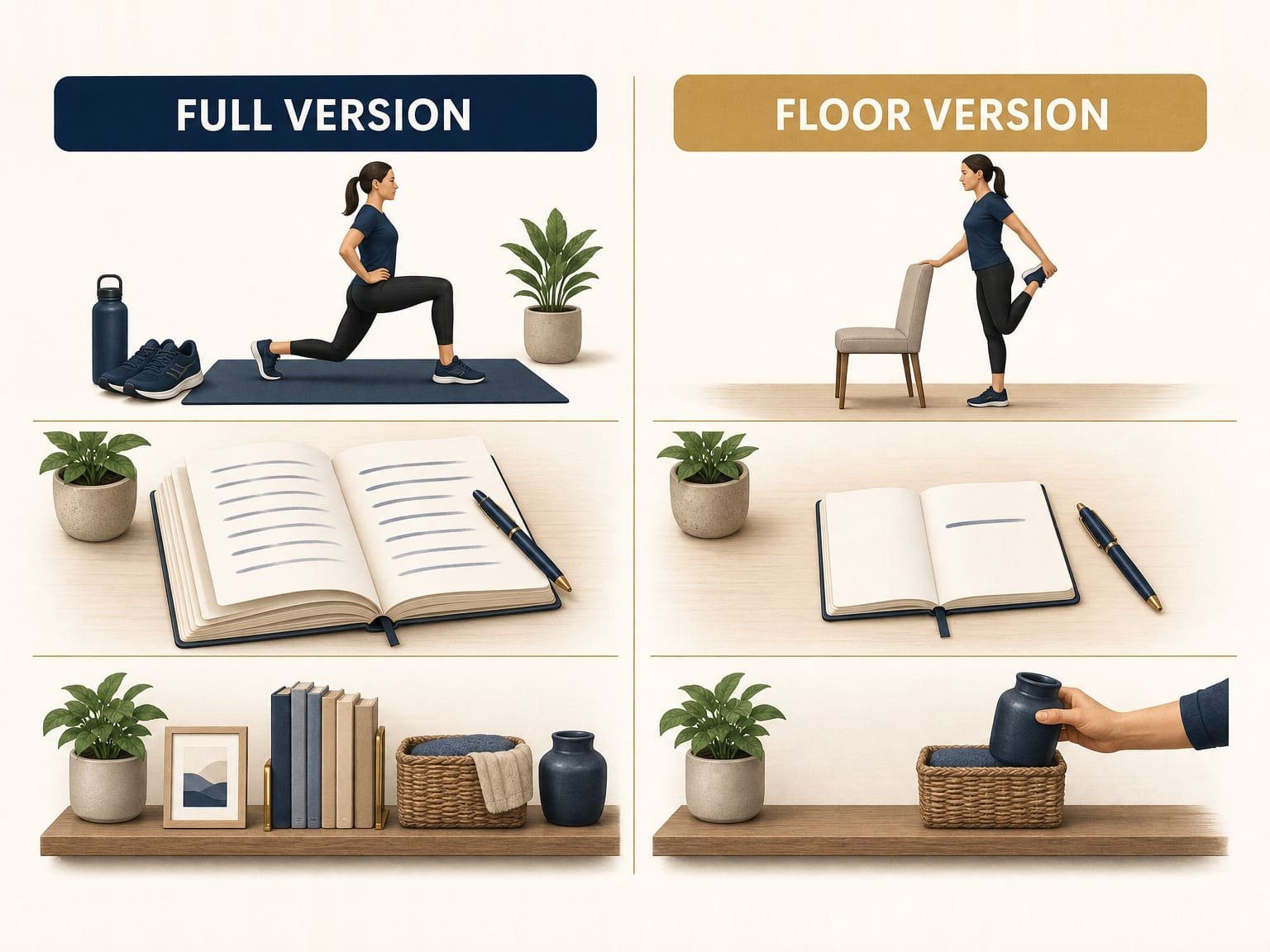
For any habit, write down two versions. The full version is what you do on a good day: a 30-minute workout, a full page of writing, a complete decluttering session. The floor version is the smallest possible version that still counts: five minutes of movement, two sentences, putting away one item. The floor version should feel almost embarrassingly easy. That is the point.
Step 2: Commit to the floor version, not the full version
Your actual daily target is the floor version, most days, as a default rather than a rigid rule. The full version is a bonus you do when you have the energy for it, not the standard you are falling short of on the days you do not. This reframing matters more than it sounds like it should, because it changes what a low-motivation day looks like. Instead of a missed habit, it becomes a floor-version day, and the habit stays intact.
Step 3: Let good days build the habit, not carry it
On days when motivation is genuinely there, do the full version. But do not treat the full version as the real habit and the floor version as a lesser substitute. Both are the habit. The floor version is what keeps the habit alive during the weeks that are hard, and the full version is what makes progress during the weeks that are not. This gives you an alternative to an all-or-nothing target, not a guarantee of long-term adherence.
Step 4: Track consistency, not intensity
If you track your habit at all, track whether you did it, floor or full version, not how much you did. A habit streak built on “did I show up” survives low-motivation stretches. A habit streak built on “did I do the full version” breaks the first time life gets hard, and once a long streak breaks, many people abandon the habit entirely rather than restart it. Removing intensity from the tracking removes that failure point.
A worked example: test the cue, not your willpower
This hypothetical example uses writing so the floor is not a fitness prescription. A reader wants to draft an article after work. Their full version is 25 minutes of drafting. Their floor is opening the draft and writing one sentence after putting their work bag down. The document is bookmarked before the week starts.
A seven-day Cue, Floor, Friction check
- Cue: Choose one event that actually happens on the intended days. “After I put my work bag down” is observable. “When I feel ready” is not.
- Floor: Write one sentence. Stopping there is permitted. Completing the floor does not mean the whole article is progressing fast enough.
- Friction: Record one short reason on a missed day: forgot the cue, could not find the draft, insufficient capacity, or a changed priority.
- Review: After seven days, change one thing. A forgotten cue calls for a more visible prompt. File setup problems call for a bookmarked draft. A capacity problem may call for another time or a pause.
Keep the record simple: date, cue happened yes/no, floor/full/paused, one friction note. There is no pass score or scientifically validated seven-day deadline here. This is a small practical experiment, not a promise of habit formation.
When making it smaller is not the answer
Rest, illness, caregiving, and changing priorities are legitimate reasons to pause. Do not interpret every missed day as a discipline problem or compensate with double work tomorrow. If the floor happens but the larger goal stalls, review the goal and available time separately. The floor protects a starting routine; it does not replace the work needed for the outcome.
Common mistakes with this method
- Making the floor version too ambitious. If the floor version still requires real motivation, it will fail on the same days the full version would have.
- Treating a floor day, or an occasional paused day, as a failure. A floor-version day still counts for this habit, and an occasional day off is a normal part of a sustainable system, not evidence that it is falling apart. The mindset shift here matters as much as the mechanics.
- Redefining the floor version upward once it feels easy. The floor version is allowed to stay embarrassingly small permanently. Its job is not to challenge you, it is to be easy enough that skipping it rarely feels necessary.
- Only applying this to one habit at a time when several are struggling. If several habits are struggling, simplify the most important one first. Pause optional routines instead of turning every habit into another daily obligation.
Where this fits with longer-term goals
Small daily habits and longer goals work together but they are not the same system. If you are also trying to connect daily consistency to something bigger you are working toward over months, see our guide on building a 90-day goal plan you will actually review, which shows how to translate the kind of consistency this method builds into progress on a longer-term goal without needing a burst of motivation to sustain it.
Keep going
If you want more frameworks like this one for building habits and discipline that survive real life rather than only your best days, our Resource Library has additional free tools and guides built around the same idea: systems that are small enough to actually stick.