



Most goal plans die within a few weeks, not because the goal was wrong, but because the plan never got broken down small enough to review regularly. A goal set once in January and not looked at again until it quietly fails in June was never really a plan. It was a wish with a deadline attached.
Ninety days is one workable length: long enough to make real progress on something that matters, short enough to stay connected to what you are actually doing week to week. It is not the only timeframe that can work, but it is a useful default. The system below turns a 90-day goal into a structure you will actually revisit, instead of one you write down once and lose track of.
Why most goal plans do not survive contact with a normal week
A goal stated at the 90-day level, “grow this,” “finish that,” “get better at X,” is too large to act on directly. There is no Tuesday task hiding inside “get healthier” or “grow the business.” Without a translation step between the big goal and the small weekly actions that actually move it forward, the goal sits at a level of abstraction that is inspiring to write down and nearly impossible to work on directly.
The other common failure is a plan with no review built in. A goal you check on only when you happen to remember it will drift, because life reliably produces more urgent, smaller things to do than the goal ever competes with day to day.
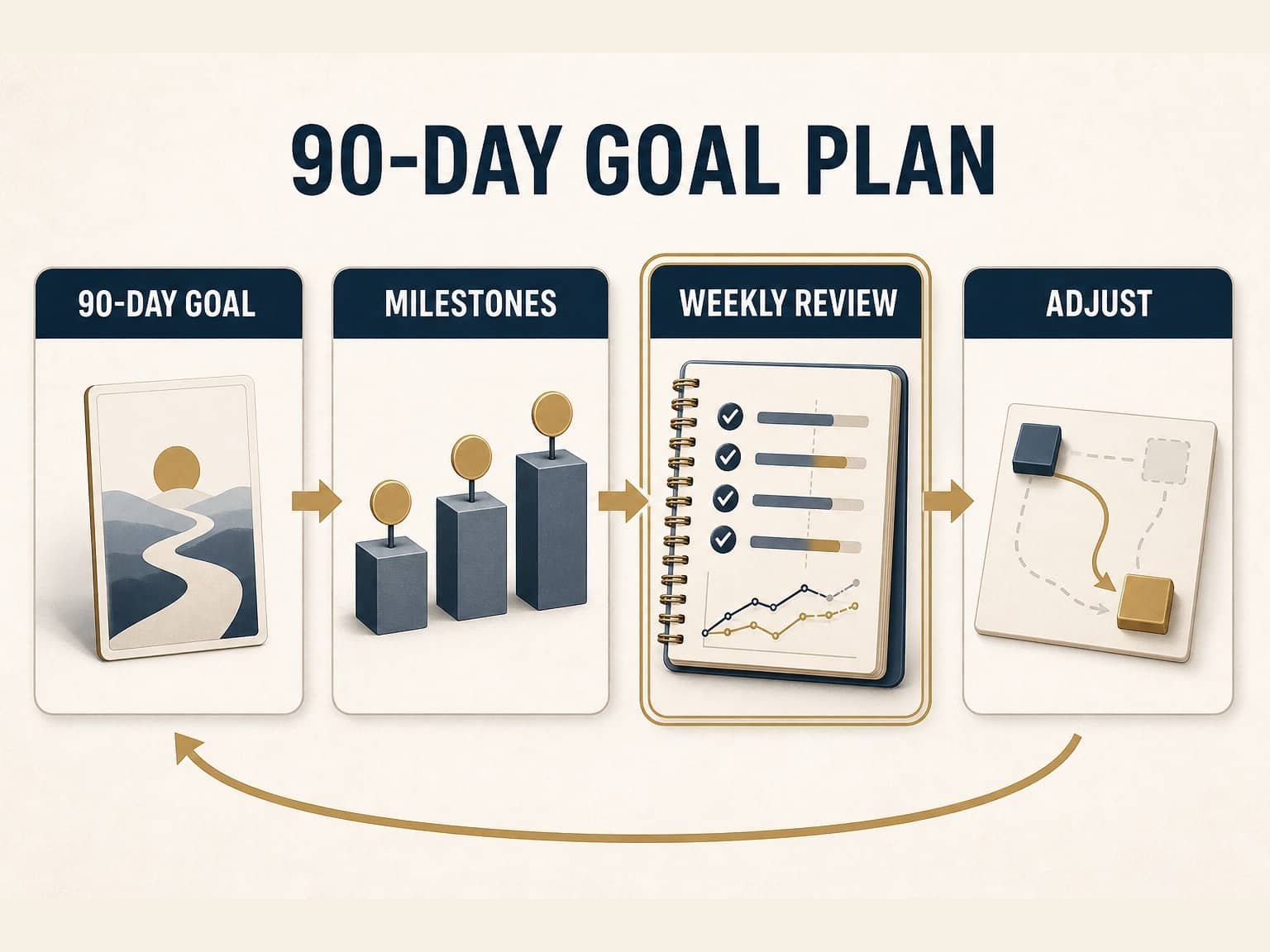
The 90-day to weekly-review framework
Step 1: Write one specific 90-day goal, not several
Pick one goal for the 90-day period. Multiple simultaneous 90-day goals usually mean none of them get the attention needed to actually move, because your weekly capacity does not multiply just because your ambition did. Make the goal specific enough that you would know clearly whether you hit it: not “improve fitness” but a specific, checkable outcome.
Step 2: Break the 90 days into three monthly milestones
Divide the goal into three roughly month-long milestones that build toward it. Each milestone should be a meaningfully different phase, not just an even three-way split of the same activity. This turns one large, distant goal into three medium-sized checkpoints, each close enough to plan around concretely.
Step 3: Break each milestone into weekly actions
For the current month’s milestone, define what needs to happen weekly to stay on pace. This is the actual translation step: the point where an abstract goal becomes a concrete Tuesday task. Only plan the current month’s weekly actions in detail. Planning all 12 weeks in granular detail up front usually wastes effort, since the plan will shift as you learn more in month one.
Step 4: Set a fixed weekly review, not an occasional one
Pick a consistent time each week, ten minutes is enough, to check progress against that week’s planned action, adjust next week if needed, and confirm the milestone is still on track. This step is what keeps a 90-day goal in active view. The American Psychological Association has summarized research finding that regularly monitoring progress toward a goal, and reporting or recording that progress, is associated with better goal attainment than setting a goal without any ongoing tracking. A fixed weekly check-in is one practical way to build that kind of monitoring into a 90-day plan.
Step 5: Do a monthly milestone review, not just a weekly one
At the end of each month, step back from the weekly detail and check the bigger picture: did the milestone happen, does the next milestone still make sense given what you learned, does the 90-day goal itself need adjusting. This higher-level check catches drift that a purely weekly view can miss, since weekly reviews can each look fine individually while the larger trajectory quietly moves off course.
A worked example
Say your 90-day goal is finishing a specific project. Month one’s milestone might be completing the foundational research and outline. Month two’s milestone is building the core version. Month three’s milestone is refining and finishing it. In month one, your weekly actions might be two dedicated research sessions and one outline-drafting session each week, reviewed every Sunday against what actually got done. At the end of month one, the milestone review checks whether the research and outline are genuinely complete, and whether month two’s plan still makes sense given what you learned during month one, before you start building the weekly plan for month two.
Common mistakes with 90-day plans
- Setting the goal and skipping the milestone breakdown. A 90-day goal without monthly milestones stays too abstract to act on weekly.
- Planning all 90 days of weekly detail up front. Detail decays fast. Plan the current month closely and the rest loosely.
- Treating the weekly review as optional when things get busy. The busiest weeks are exactly when review matters most, since that is when goals are most likely to get quietly dropped.
- Never revisiting the goal itself. A goal that made sense on day one may need adjusting by day 45, once you know more than you did at the start.
Where this connects to daily consistency
A 90-day plan sets the direction. Whether you actually show up for the weekly actions on the hard days depends on habit systems, not just planning. If low motivation is what tends to derail your progress week to week, see our guide on building habits when motivation is low, which pairs directly with the weekly review structure described here.
Build your plan
For more free tools on goal setting and structured review habits, our Resource Library has additional resources to help you turn a goal into a plan you will actually revisit. If you also want an AI-assisted system for organizing your weekly planning around a goal like this, the AI Productivity Planner can help structure the weekly execution side of this framework.