



A side project can stall for a lot of reasons, and a weak idea is one of them, but an unsustainable schedule is another common one that gets less attention. Trying to treat a side project like a second full-time job, on top of the first one, tends to produce exhaustion and inconsistency rather than steady progress. The people who keep side projects going while working full time are not usually working more hours than everyone else. They are protecting a smaller, sustainable set of hours and defending the boundaries around the rest of their time.
Why side projects burn people out specifically
A side project has a structural problem a full-time job does not: it has no natural end to the workday. Your job ends when you leave, log off, or close the laptop. A side project is always there, waiting for the next open evening, which means the boundary between working on it and resting has to be built on purpose, because nothing external is going to enforce it for you.
This is made worse by the fact that side projects usually start with a burst of motivation. Early enthusiasm covers up an unsustainable pace for a few weeks. Then the initial excitement fades, the day job’s demands do not, and the project either gets abandoned or keeps running on time and energy that should have gone to rest, relationships, or recovery.
A time-boundary system for a sustainable side project
Step 1: Decide your weekly time budget before you start, not after you are exhausted
Pick a specific, realistic number of hours per week you are actually willing to give the project, and treat that number as fixed rather than aspirational. Most people vastly overestimate how many hours they can sustainably add on top of a full-time job. A smaller number you actually hit every week beats a bigger number you hit twice and then abandon.
Step 2: Protect specific blocks, not vague intentions
“I’ll work on it in the evenings” is not a boundary, it is a hope. Pick specific blocks, for example two weeknights and a Saturday morning, and treat those blocks the way you would treat a meeting you cannot casually skip. A vague intention gets displaced by whatever else is happening that evening. A specific block on the calendar is much harder to quietly erode.
Step 3: Set a real stopping point for each session
Decide in advance when a work session ends, and actually stop there, even mid-task. Side project burnout often comes less from the total hours worked and more from sessions that have no boundary, where “just one more thing” turns two hours into four, repeatedly, until the project starts eating into sleep and the rest of your life.
Step 4: Build in a genuine recovery day
Protect meaningful recovery time every week as a structural part of the system, not as a reward for being productive enough. For some people that means a full day with zero side project work. For others it works better as another clearly protected block instead of a whole day. What matters is that some real recovery time exists and is treated as non-negotiable, since continuous work without any recovery tends to build toward exhaustion gradually enough that it is easy not to notice until it is already a problem.
Step 5: Review your boundaries monthly, not just your progress
Most people track project progress. Fewer people check whether their boundaries are actually holding. Once a month, honestly ask whether you are sticking to your planned hours, or whether the project has been quietly expanding into time you meant to protect. Catching boundary drift early is much easier than recovering from months of it.
A worked example
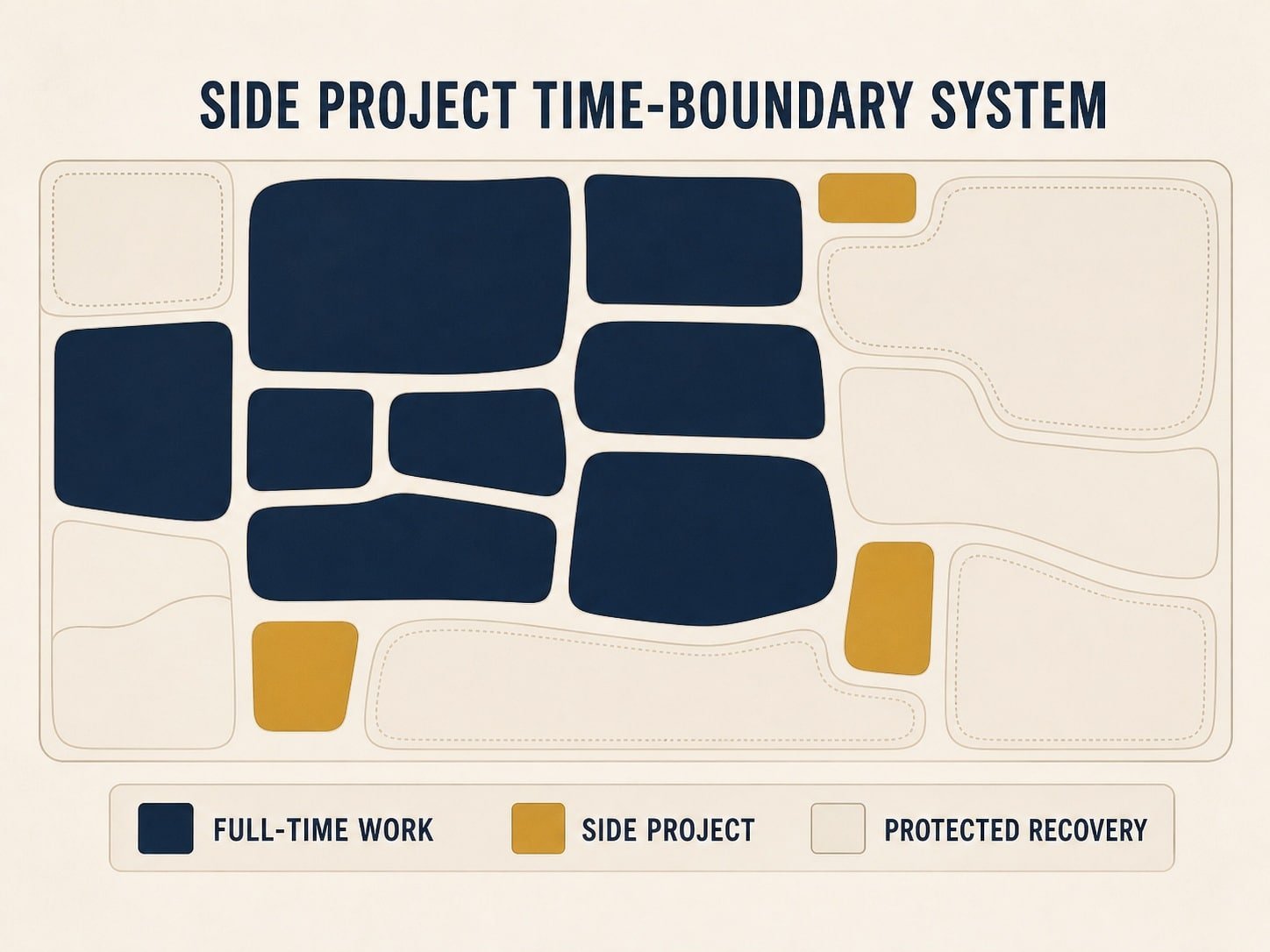
Say you work a standard full-time job and want to build a side project. Under this system, you might set a budget of six hours a week: two weeknight sessions of two hours each, plus a two-hour Saturday morning block. Each session has a defined stopping point, even if you are mid-task when it arrives. Sunday stays completely off-limits to the project. At the end of each month, you check whether those six hours actually held, or whether the project crept into extra evenings you did not plan for. If it crept, the fix is tightening the boundary, not accepting the new normal.
It is worth noting that the World Health Organization defines burnout specifically as an occupational phenomenon resulting from chronic unmanaged workplace stress, not a clinical diagnosis applied to side projects themselves. The system below borrows the general idea, protecting against overload and unsustainable schedules, without claiming a side project on its own causes clinical burnout.
Common mistakes that lead to burnout
- Setting an unrealistic weekly hour target because of early enthusiasm. The number that feels achievable in week one is often unsustainable by week six.
- Treating every evening as available if the mood strikes. Unscheduled time gets absorbed by whatever feels urgent that day, and the project usually loses.
- Never taking a full day off from the project. Recovery time is not wasted time. It is what makes the other hours sustainable.
- Measuring success only by output, never by whether the pace is sustainable. A project built on an unsustainable pace eventually stops, regardless of how much progress it made before that point.
Where this fits with validating the project itself
Protecting your time and energy is only useful if the project is actually worth building. If you are still deciding whether a specific skill or idea deserves that protected time in the first place, see our guide on how to know a skill is worth turning into a digital product, which covers validating and scoping an idea before you commit real hours to it.
Keep building sustainably
For more free tools and frameworks on managing time, energy, and side projects without burning out, our Resource Library has additional guides built around the same sustainable-pace approach used here.