



AI tools can state an incorrect claim as confidently as a correct one. Tone is not a reliable accuracy check. That is the core problem with using AI for research, writing, or decisions: the output looks equally trustworthy whether it is accurate or not. The fix is not to stop using AI. It is to build a habit of verifying before you act on anything that actually matters.
Why AI-generated information needs a different kind of scrutiny
Many current AI tools can browse, retrieve sources, and show citations alongside an answer, which is a real improvement over tools with no sourcing at all. But a polished answer with citations attached does not by itself guarantee that every claim in it is accurate, or that a given citation actually supports the specific sentence next to it.
The National Institute of Standards and Technology describes this pattern in generative AI systems as confabulation: the tendency to confidently produce erroneous or fabricated content that is not grounded in the input or in reality, often in the same tone as accurate content. NIST’s Generative AI Profile (2024, sections 2.2 and 2.7) also points to automation bias, the human tendency to over-rely on automated systems and under-scrutinize their output, as a related risk. You cannot reliably tell, just by reading an answer, whether it falls into this category, and the cost of getting that wrong ranges from mildly annoying to genuinely costly depending on what you are using the information for.
The AI verification decision process
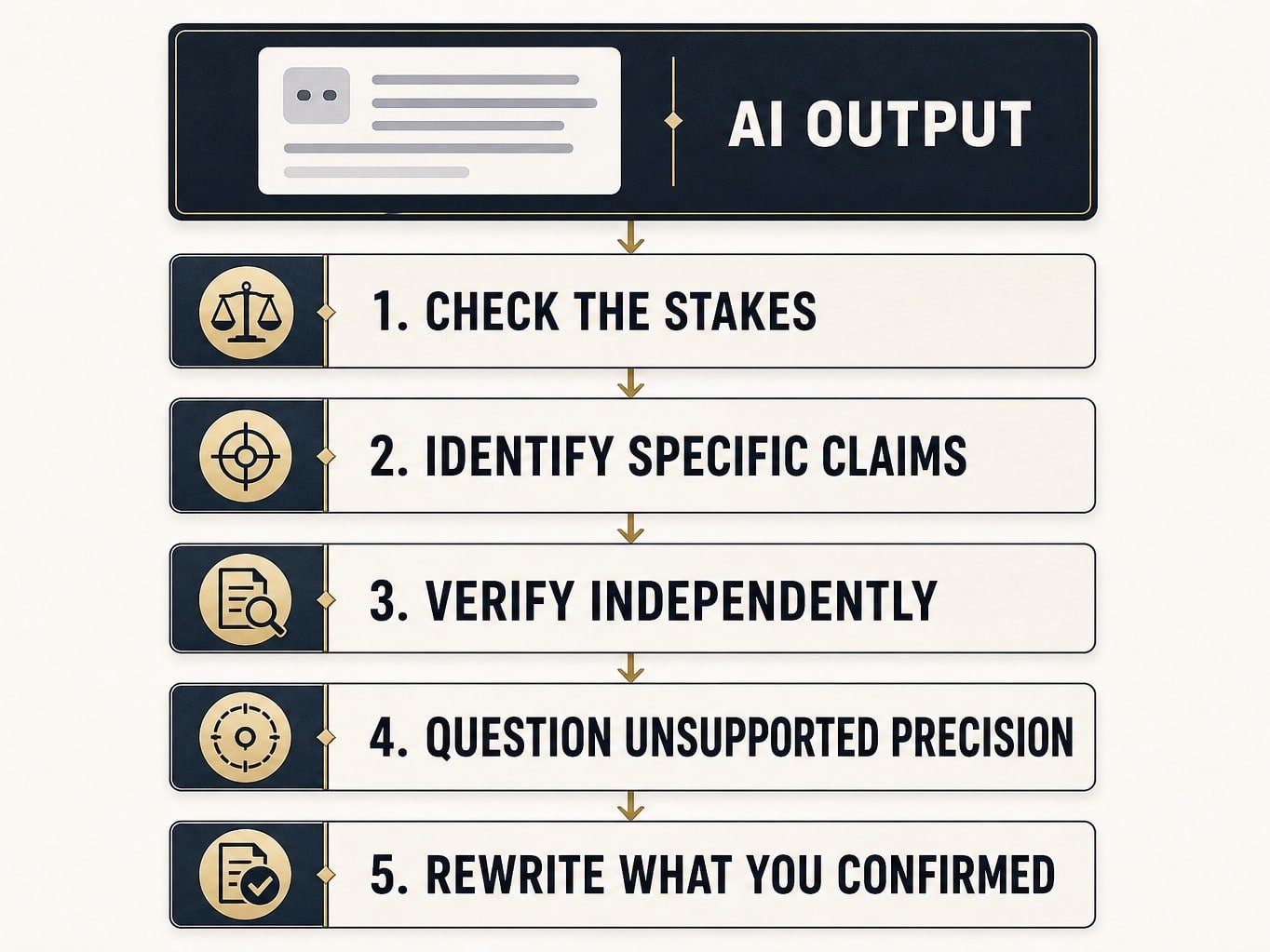
Not every AI answer needs the same level of scrutiny. A brainstorm for a birthday card message does not need fact-checking. A number you are about to include in a work report does. The process below scales the verification effort to match the actual stakes.
Step 1: Sort the claim by stakes, not by how confident it sounds
Before verifying anything, ask what happens if this is wrong. Low-stakes: creative brainstorming, casual conversation, a first draft you will edit anyway. Medium-stakes: something you will share with others or use to make a small decision. High-stakes: financial numbers, health information, legal information, anything you will publish, or anything a decision depends on. The higher the stakes, the more verification the claim needs, regardless of how confident the AI sounded when it gave you the answer.
Step 2: Separate general knowledge from specific facts
Broad explanations and specific facts need different checks. Neither is automatically reliable: inspect the reasoning in an explanation and trace numbers, dates, names, and citations to an original source. A general explanation of how compound interest works is lower risk than a specific interest rate figure. A general description of a common process is lower risk than a specific statistic attributed to a named study. A checkable fact gives you a clear verification target, not evidence that the answer is correct.
Step 3: Verify specific facts against a primary or authoritative source
For anything medium or high stakes, do not stop at asking the AI to confirm itself, since a tool that generated a wrong answer with confidence will often defend that same answer with equal confidence if you just ask it to double check. Instead, search for the specific fact independently: a government source, an official organization, a primary document, or a source you would trust even without AI involved. If you cannot find independent confirmation of a specific fact, treat it as unverified rather than assuming it is probably fine.
Step 4: Watch for confident-sounding specifics with no clear source
A useful pattern to notice: AI tools sometimes produce very specific numbers, quotes, or citations that sound precise enough to be real, but are not attached to anything you can actually check. A specific-sounding statistic with no named source attached is a signal to verify, not a signal that it is more credible because it is specific. Precision is not the same as accuracy.
Step 5: Rewrite in your own words once verified
Once you have confirmed a fact independently, do not just copy the AI’s original phrasing back into your work. Rewriting it in your own words, matched to what you actually verified, keeps your language honest about your actual level of certainty instead of inheriting the AI’s confident tone by default.
A worked example: the source exists, but the claim does not match
This is a hypothetical editing exercise, not a BMV101 case study. Imagine an AI draft says, “59% of Americans faced an unexpected medical expense in 2025.” The Federal Reserve’s 2025 SHED report, published in May 2026, table 23 reports 59% of U.S. adults had at least one major unexpected expense of any listed type in the prior 12 months. Unexpected major medical expenses were reported by 21%. The citation is real, but the draft has confused a combined category with one component.
Use a Claim, Source, Match, Decision note
- Claim: Copy the exact sentence you intend to use, including the population, period, and measure.
- Source: Record the original report title, publication date, URL, and table or section. Open it yourself, not just an AI summary.
- Match: Check whether the number describes adults or households, one expense type or all types, a survey response or a measured effect. Read the table notes.
- Decision: Correct the sentence to the supported claim, narrow it, or omit it. If the source is unavailable, mark the claim unresolved in your working notes and do not use it as evidence.
For this exercise, a supported sentence would describe major unexpected expenses among U.S. adults, not medical expenses alone. It would not predict an individual reader’s risk. Replacing an unverified number with a vague trend does not verify the trend either.
When the check is not enough
For medical, legal, tax, or consequential financial decisions, a matching citation is only a starting point. Check current applicability with a qualified professional or the responsible authority. Two chatbots agreeing is not independent confirmation. Keep private source material out of tools unless its use is authorized.
Where this fits into a daily AI habit
This verification process works best as part of a broader daily approach to using AI responsibly, not just a one-off check for important claims. For a simple everyday method that builds verification into how you use AI on regular tasks, see our guide on the Plan, Prompt, Verify AI workflow, which applies this same verify-before-you-act principle to day-to-day AI use beyond just fact-checking.
Build the habit
If you are working on using AI more responsibly across your daily productivity, not just for fact-checking, the AI Productivity Planner includes this verification approach as a built-in part of its 30-day system. You can also start with the free 7-Day AI Productivity Starter Kit for a shorter introduction to responsible daily AI use.