



Scattered due dates and payment methods can make bills hard to track, even when you intend to pay on time. By the time a bill becomes visible, it is already close to late.
You do not need a complicated budgeting system to fix this. You need one simple bill calendar and a short monthly routine to keep it current. This guide walks through the method, based in part on the bill calendar approach recommended by the Consumer Financial Protection Bureau, adapted into a system you can set up in under an hour and maintain in minutes a month.
Why complicated budgets fail at this specific problem
Full budgeting systems try to solve spending, saving, and bill tracking all at once. That is useful, but it is also why so many people abandon them: the bar to get started is high, and if you fall behind on the system, you fall behind on everything it was tracking, bills included.
Bill organization is a narrower problem with a narrower fix. You do not need to categorize every purchase to stop missing a due date. You need one place that shows every bill, when it is due, and whether it has been paid, updated once a month.
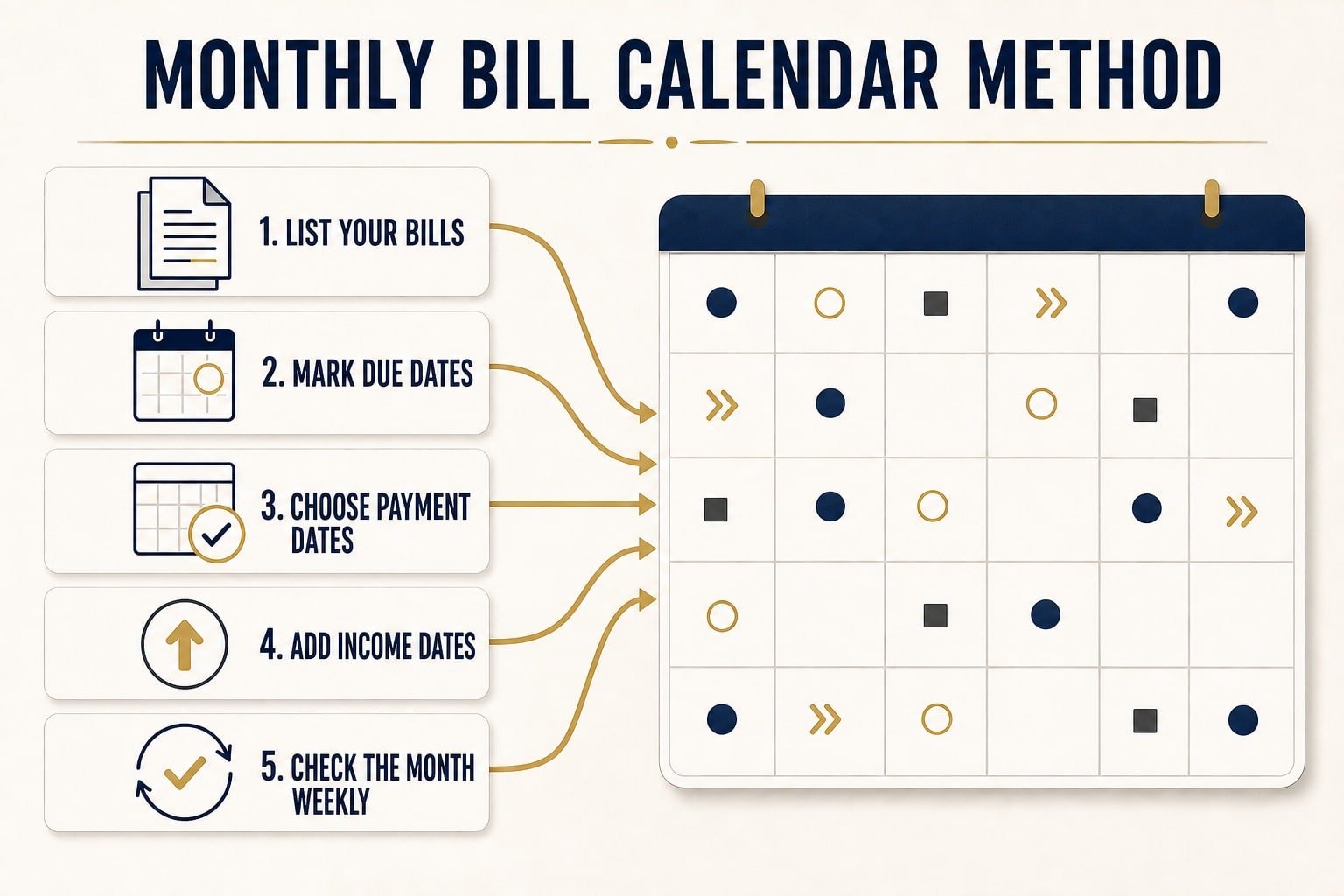
The simple monthly bill calendar method
Step 1: List every recurring bill in one place
Write down every bill you pay regularly: rent or mortgage, utilities, phone, internet, insurance, subscriptions, loan payments, credit cards. For each one, note the due date and the amount, even if the amount varies slightly month to month. This list is the foundation everything else builds on, and it usually takes people longer to build than they expect, mostly because subscriptions and smaller bills get forgotten until they are written down.
Step 2: Put every due date on one calendar
Take that list and put every due date onto a single calendar, whether that is a paper calendar, a spreadsheet, or a printed monthly tracker. The Consumer Financial Protection Bureau’s own bill calendar approach involves marking each bill’s payment date, and for bills paid online or in person, marking a reminder roughly two to three days before the due date to reduce the risk of a late payment. It also involves adding your income dates and amounts to the same calendar and comparing weekly bill totals against weekly income, so you can see whether a given week’s bills add up to more than that week’s income before it becomes a problem. Seeing every due date on one page, instead of buried inside separate accounts and apps, can make upcoming payments easier to spot, but does not guarantee payment or solve a shortage of money.
Step 3: Compare due dates against paydays
Once every bill is on the calendar next to your paydays, compare each week’s bill total against that week’s income, the way the CFPB’s worksheet does. If a week’s bills add up to more than that week’s income, that is a structural timing problem, not a discipline problem. It is worth asking whether some of those due dates can be changed. Many billers, credit cards and utilities in particular, will consider a due date change on request, though whether they grant it depends on the company and your account.
Step 4: Decide what gets automated and what does not
A fixed amount is not automatically safe to automate. Before authorizing a debit, check the provider, amount, withdrawal date, available balance, other pending payments, and the authorization terms. Keep a reminder to review both fixed and variable charges and confirm that the payment actually cleared.
The CFPB’s automatic-payment guidance warns that insufficient funds can lead to overdraft or nonsufficient-funds fees. If your balance or income timing is unpredictable, a reminder-based manual review may be more suitable than an automatic debit. Choosing a method does not create funds to cover a bill.
Step 5: Run a five-minute monthly update
Once a month, update the calendar: check off what was paid, add any new bill or subscription, and remove anything that ended. This is the step that keeps the whole system accurate. A bill calendar built once and never updated slowly drifts out of sync with reality, which is exactly the failure mode this method is designed to avoid.
What to do if you are already behind
If you are catching up rather than starting fresh, do the list and calendar steps first, but add one more: mark which bills are currently overdue and roughly how overdue they are. The CFPB advises contacting the lender or company directly and asking what assistance is available. Depending on the provider and your situation, that may include more time to pay, a changed due date, or a waived late fee, though none of this is guaranteed, and what is offered varies by company. Getting current is a separate project from staying current, and trying to do both with the same amount of effort at the same time is usually where people get discouraged and stop.
Educational and organizational only. Not financial, tax, legal, investment, credit, or professional advice. No specific financial result is guaranteed.
Where this fits into a bigger money system
A bill calendar solves one specific problem: knowing what is due and when. It does not, on its own, tell you whether you are spending more than you should be, or whether some of those bills are subscriptions you forgot you had. For that side of the picture, see our guide on auditing your subscriptions and finding spending leaks, which pairs naturally with the bill calendar you just built.
If you want both of these folded into one repeatable monthly habit instead of two separate processes, our 30-minute monthly money review shows how to run the bill check and the subscription audit together in a single sitting. For the source behind the bill calendar method in this guide, see the Consumer Financial Protection Bureau’s bill calendar resources.
Make it stick
If you want a printable version of this exact system, one built to be filled in by hand each month rather than assembled from scratch, the Simple Money Reset Workbook includes a ready-to-use bill calendar along with the rest of a 30-day money organization system.
If you want to try a shorter version first, the free 7-Day Money Reset Starter Kit includes a simplified version of this bill tracking method you can start today.