



Plenty of people have a skill someone else would pay for. Far fewer have evidence that this specific skill, packaged in this specific way, will actually sell. The gap between “I could probably make something out of this” and an actual product that generates income is where most side projects stall out. This guide is not a list of product ideas. It is a way to test whether a skill you already have is worth turning into something you sell, before you spend weeks building it.
Why most first products fail before they launch
The common failure pattern looks like this: someone is genuinely good at something, decides it should be a course, template, or digital product, spends weeks building the full version, and only then finds out whether anyone actually wants to pay for it. By the time they find out, the sunk cost is already spent. The fix is not to skip building things. It is to test the idea in its smallest possible form before committing real time to the full version.
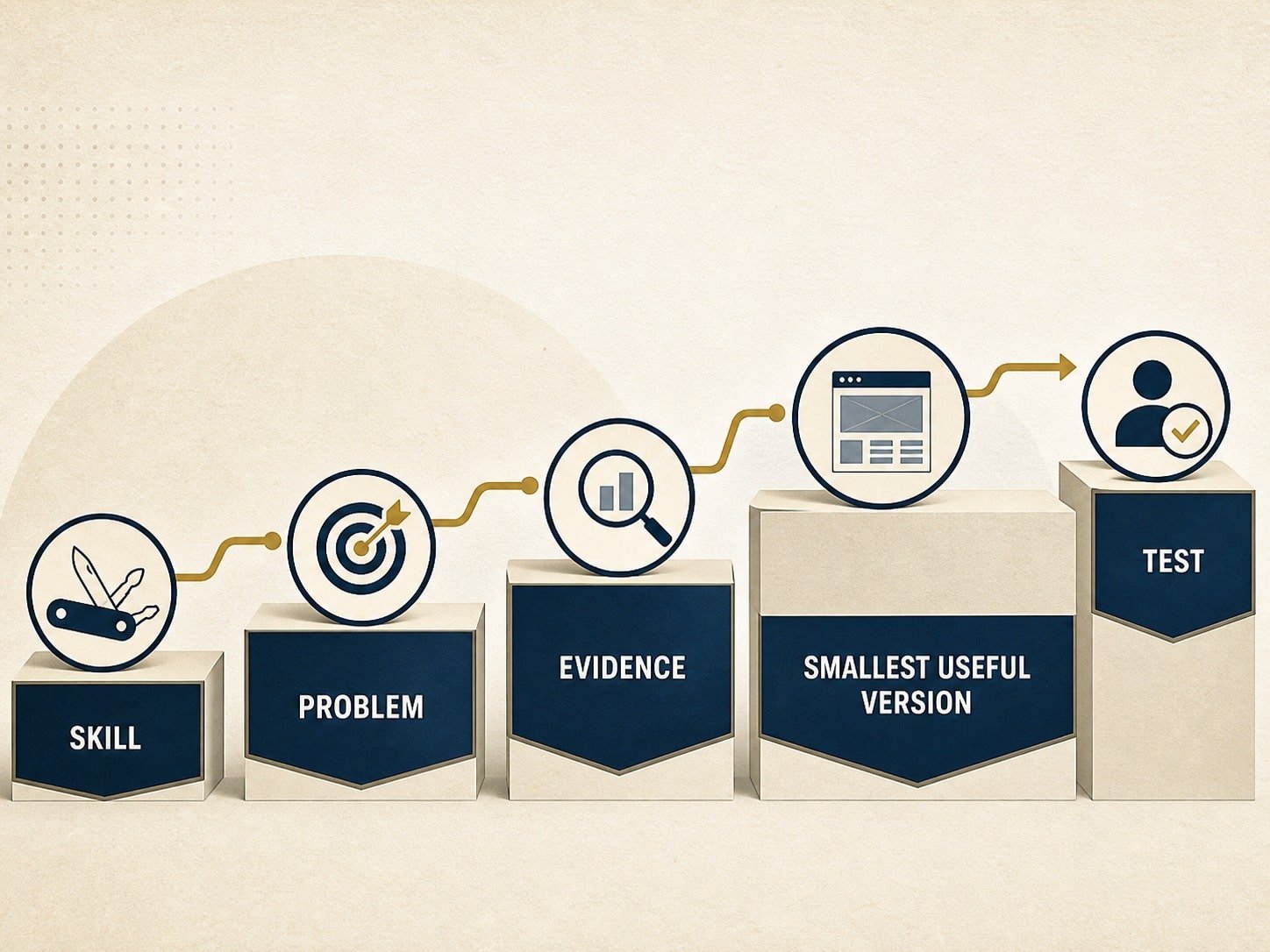
The Skill, Problem, Evidence, Smallest Useful Version, Test framework
Step 1: Name the skill precisely
Not “I’m good at marketing.” Specifically what part of marketing, for what kind of business, at what stage. A precise skill is easier to test and easier to package than a broad one. If you cannot describe your skill in one specific sentence, that is worth sitting with before moving to the next step.
Step 2: Name the problem it solves, for someone specific
A skill only becomes a product when it solves a problem for a specific person, not “everyone who wants to learn X.” Who has this problem right now? What are they currently doing about it, badly, expensively, or not at all? If you cannot name a specific person or specific type of person with this problem, the skill may be real, but the product idea is not yet formed.
Step 3: Look for evidence before you build anything
Before writing a single page of content, look for signals that this problem is one people already try to solve, not just one you think they should care about. The U.S. Small Business Administration recommends using market research at this stage to understand demand, identify who your customers actually are, and assess existing alternatives or competition, since that research is what reduces risk before launch rather than after it. Are people asking about this in communities, forums, or comment sections? Are there existing products, even imperfect ones, addressing something adjacent? Have people directly told you they would pay for help with this? Weak or absent evidence at this stage does not mean the idea is dead, but it means you should test smaller and more cheaply before investing more time, not skip straight to a launch.
Step 4: Build the smallest useful version
Not the smallest version of the idea, the smallest version that is genuinely useful on its own. A single worksheet that solves one piece of the problem. A short guide that answers the one question people ask most. A framework someone could apply in an afternoon. The goal is not to under-deliver; it is to find out if the core idea has value before you invest in the full, expanded version.
Step 5: Test it with real people, not just yourself
Put the smallest useful version in front of actual people who have the problem you identified in Step 2, not just friends who will be kind about it. Are they willing to pay something for it, even a small amount? Do they finish it and get real value, or do they stall out? Their actual behavior, not their polite feedback, is the signal that matters here.
A worked example
Say you are skilled at organizing chaotic email inboxes for busy people. Naming the skill precisely: inbox triage systems for people who get 100-plus emails a day and feel behind. Naming the problem: people in this situation lose track of important emails and feel constant low-grade anxiety about their inbox. Evidence: productivity forums are full of people asking how to deal with inbox overload, and several existing apps address pieces of this problem. Smallest useful version: a one-page triage decision framework, not a full course. Test: give it to five people who described this exact problem, and see whether they actually use it and whether they would pay for a more complete version.
Where this connects to protecting your time
Testing an idea this way takes real time, even in its smallest form, and that time has to come from somewhere in an already full schedule. If you are building this alongside a full-time job, see our guide on starting a side project without burning out for a system to protect the time this kind of testing requires without sacrificing your recovery time.
Common mistakes
- Building the full product before testing the smallest version. A common mistake is building the full version before gathering enough evidence that the problem and audience are real.
- Treating friendly feedback as evidence. People close to you will rarely tell you an idea is weak. Look at what strangers with the actual problem do, not what friends say.
- Skipping Step 2 and jumping to “what should I make.” A skill without a specific problem attached is not yet a product idea.
- Waiting for certainty before testing anything. The test exists because certainty is not available in advance. Small, cheap tests replace guessing.
Next step
If you want more structured tools for organizing this kind of project validation and turning it into a real system, our Resource Library has additional planning resources to support the testing and building process.